
“More” Isn’t the Answer. Different Is.
Fund Cognition-First AI that learns, updates, adapts and delivers real intelligence.

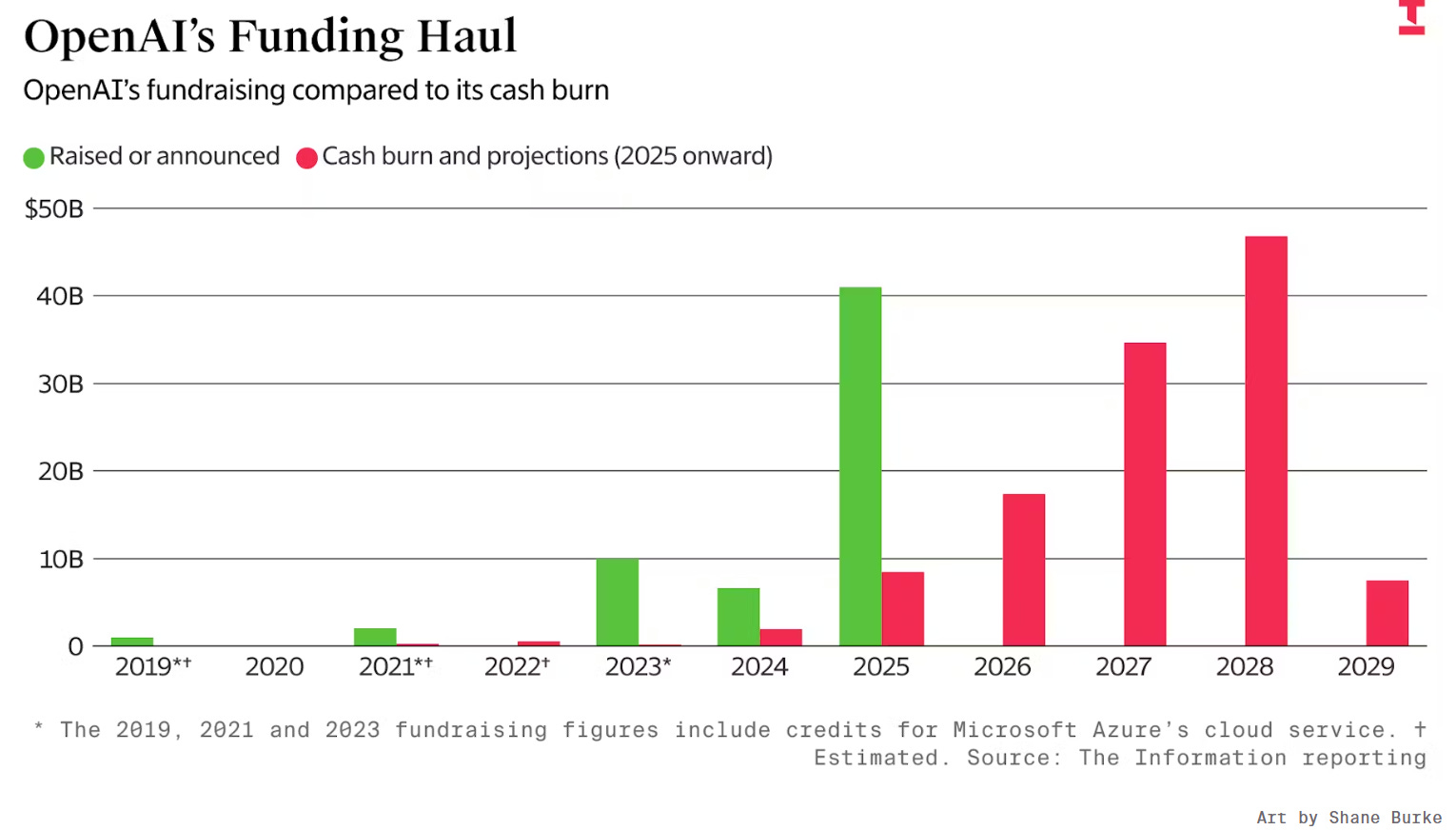
GenAI is subsidyware, not software. The economics are upside down: every user is investor-subsidized, every new query and every new user raises marginal cost, the reverse of how software is supposed to scale. And despite the burn, real intelligence never shows up.
So ask the only questions that matter: Why are we scaling it? What exactly are we still subsidizing?
In the scale-first paradigm, “more” is the only answer to every problem.
Here we are again: OpenAI is asking for another $80B after raising $57B already. And no, the ask won’t stop, because the architecture can never deliver.
Whether it’s ignorance, intellectual dishonesty, or plain old greed, the tab lands on all of us. This isn’t a one-off lapse; it’s the house playbook across the LLM bazaar. Costs compound. Capability flatlines. “Progress” is just packaging. Investors bankroll it, the grid buckles, and ultimately the public pays.
Because the architecture can’t cross its own ceiling. What’s missing is this:
no incremental learning
no autonomous adaptation
no real-time model updates
no causal reasoning or counterfactuals
no reliability for any business to bank on
If a system can’t learn as it operates, can’t reason about cause and effect, and can’t guarantee repeatable outcomes, “more” only scales fragility.
Compute theater, Planetary bill
Here’s how it will play out:
First the investors will be exhausted, then the grid, then the public. We bulldoze sites for data centers, torch rivers for cooling, and lock enterprises into brittle stacks while failure modes multiply. This isn’t ambition, it’s mindless flex with a massive power bill.
The unit economics never penciled. You’re not scaling intelligence; you’re scaling losses. Don’t compare this to Amazon, this isn’t a logistics flywheel, it’s a capex treadmill.
Fund Adaptation, not Scale
If you’re wiring funds, demand cognition-first milestones or walk:
Incremental learning in production (no whole-model retrains)
Adaptive, causal world models with counterfactual reasoning
Persistent, auditable memory (self-consistency, not prompt glue)
Reliability SLAs proven in live traffic, not demo reels
Energy & cost caps that fall as capability rises
If they can’t hit these, you’re not financing intelligence, you’re underwriting the world’s most expensive fluency engine and a new class of stranded infrastructure.
The ask will never stop because this architecture can’t deliver what it promises. More chips won’t fix a model that can’t learn incrementally.
Stop funding “more.” Start funding cognition-first systems that delivers real intelligence.
Dig Deeper: